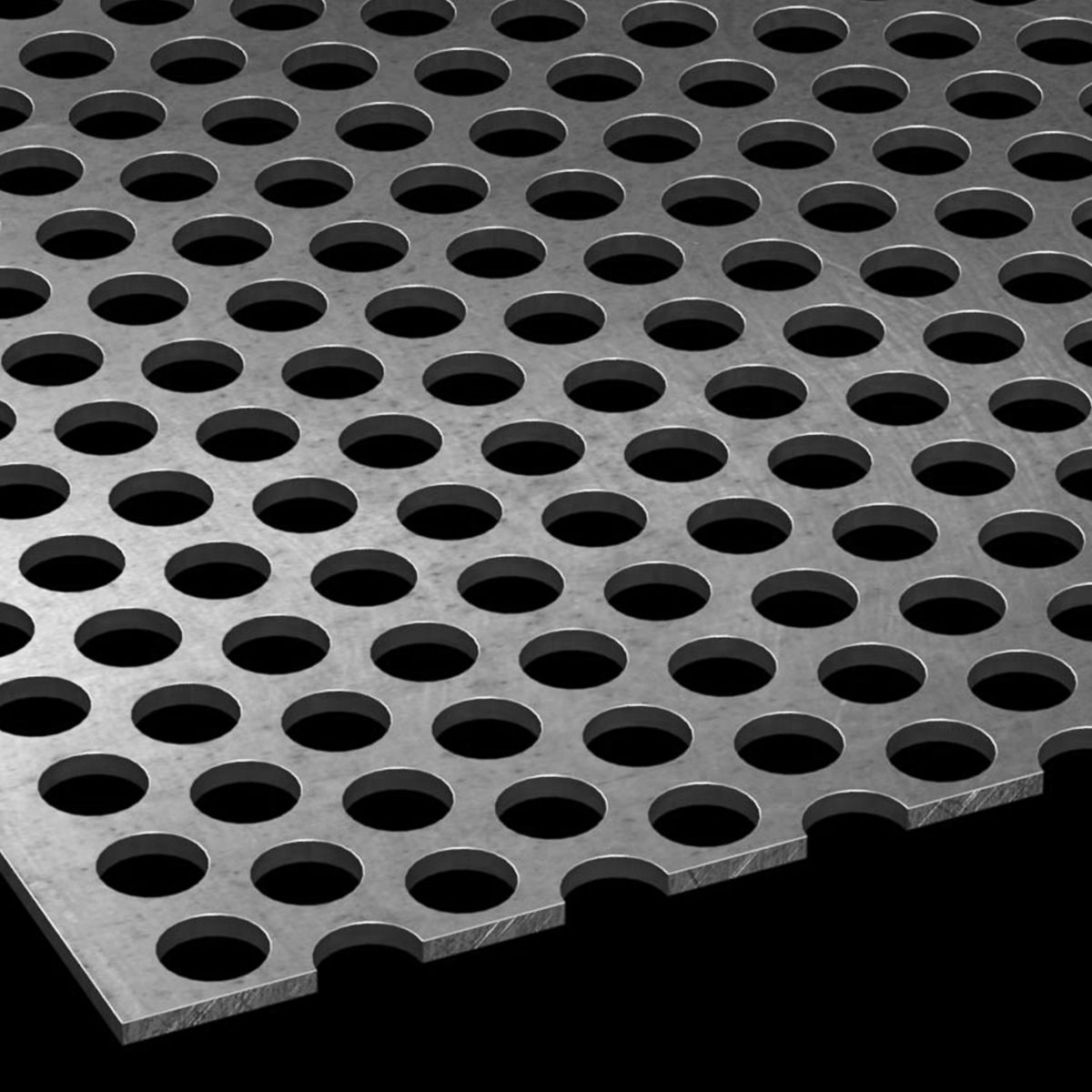
Perforated metal sheet
Sheet thickness: 0.2 – 6.0 mmHole size: 0.5 – 30 mm
A sheet of aluminium slit and stretched into a diamond lattice — light enough to hang from a ceiling grid, stable enough to clad a facade, and it never needs a zinc layer. Chinese trade name: 铝板网.
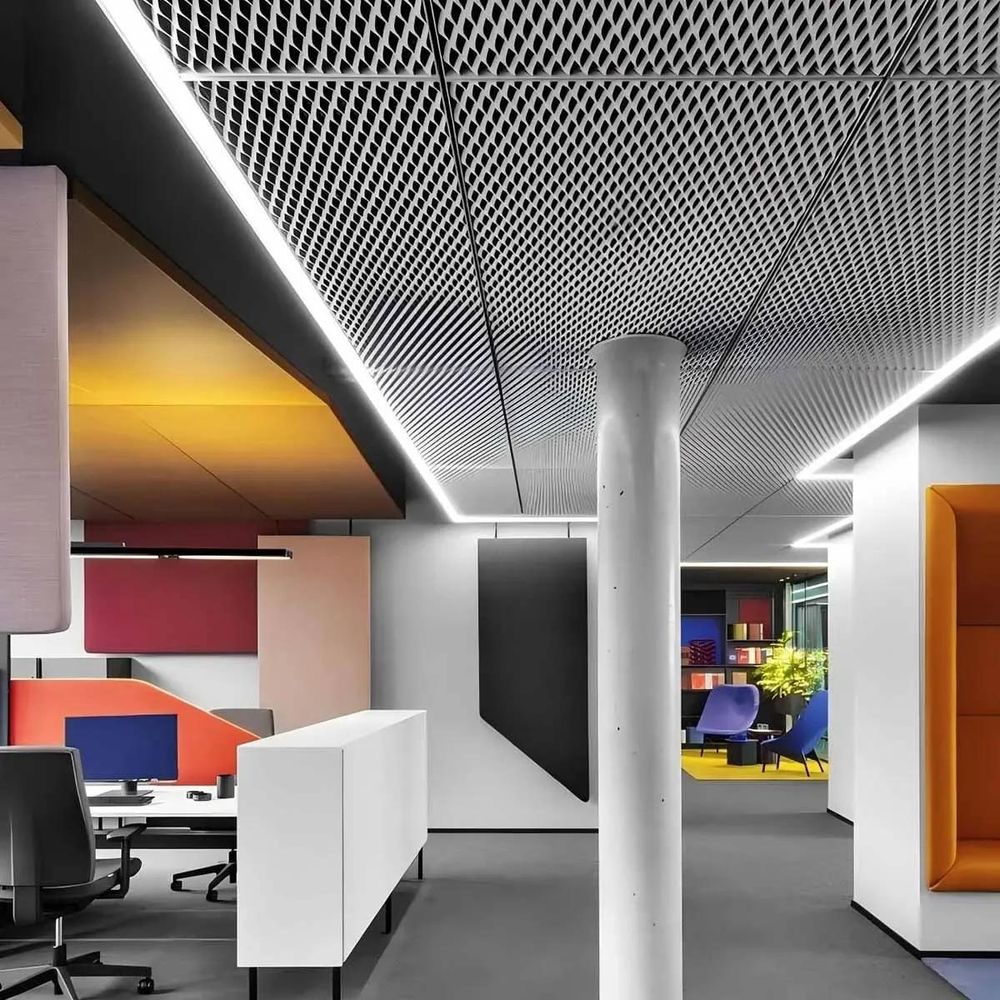
Aluminium expanded mesh ceiling panels installed in an office interior.
Standard production range for this line. Anything outside it is a conversation, not a refusal — tell us the application and we will say what the tooling can hold.
A sample panel and a mill certificate come before the container does. Ask for both with the first quotation.
| Alloy and temper | AA 1050 / 1100 / 3003 H14; 5052 for marine and coastal |
| Sheet thickness | 0.5 / 0.8 / 1.0 / 1.2 / 1.5 / 2.0 / 2.5 / 3.0 mm |
| Mesh size | SWM 5 – 60 mm, LWM 10 – 120 mm, strand width 0.8 – 5 mm |
| Open area | 30 – 70 %, depending on mesh and strand |
| Panel size | 1000 × 2000, 1220 × 2440 mm; custom up to 1500 × 3000 mm |
| Finish | Mill; anodised clear, champagne, bronze or black; powder coat to RAL; PVDF / fluorocarbon for exterior |
| Fixing | Ceiling grid clips, hook-on panels, frame and clamp, or self-tapping to a mullion |
| Packing | Film-wrapped on pallets, or in crates for cut panels |
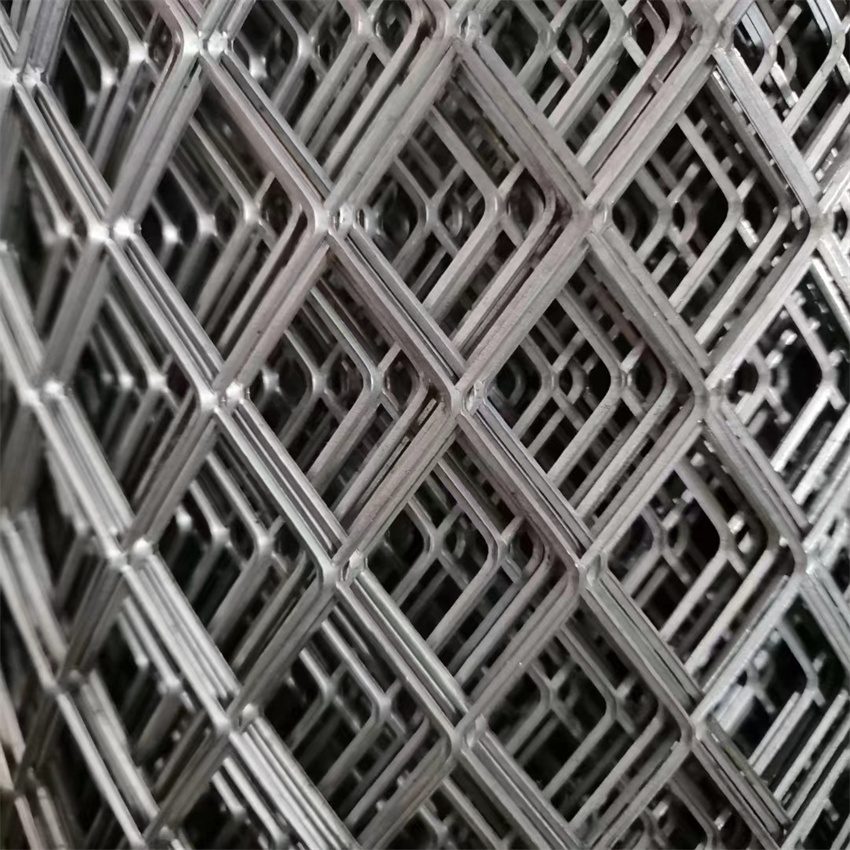
Aluminium expanded mesh is made the same way as the steel version: the sheet is slit and stretched, and the whole panel becomes product with no welding and no offcuts. What changes is the material — a third of the weight of steel, no zinc coating to specify, and a finish that can be anodised to a colour rather than painted over a rust barrier.
Most of it ends up overhead: suspended ceiling panels, ventilation screens, facade infill, partitions, signage. Because it is light, a 1200 × 2400 mm panel can be handled by two people and fixed to a standard ceiling grid without additional steel.
Weight is the argument. Aluminium expanded mesh runs roughly a third of the weight of the same steel panel, so the ceiling grid, the fixings and the lifting gear all get cheaper, and a retrofit does not need new structural support. It also cannot rust — an interior ceiling in a humid or coastal building needs no maintenance cycle at all.
The catch is stiffness. Aluminium deflects about three times as much as steel at the same thickness, so a large ceiling panel needs a deeper frame or a coarser mesh with wider strands. This is quoted from the panel size, not from the sheet alone.
AA 1100 and 3003 are the workhorses: 1100 is softer and cheaper, 3003 is stiffer and machines better. For coastal or marine work, 5052 with a PVDF finish is the specification that holds up.
Anodising gives a hard, transparent oxide layer and a metallic look — clear, champagne, bronze or black. Powder coat gives an opaque RAL colour at lower cost. PVDF (fluorocarbon) is the exterior grade: it keeps its colour for decades, where a powder coat on a sun-facing wall may chalk within a few years.
Three fixing patterns cover most ceiling work: hook-on panels on a standard T-grid, clip-in panels with a concealed grid, and tensioned panels held between edge frames. Tell us which system the project uses and the panels are produced to that module — usually 600 × 600, 600 × 1200 or 1200 × 2400 mm.
For facades the panels are usually framed and clamped, with a fixing detail from the curtain-wall supplier. We supply the mesh and the clamp bars; the fixing design and the wind-load calculation belong to the facade engineer.
Aluminium expanded mesh cuts quickly with a guillotine or a jigsaw. The open lattice means edges are ragged unless they are framed or trimmed — for exposed edges we can supply a flat border band or a return leg, which is what a ceiling detail usually calls for.
Typical applications for this line. If yours is not listed, it usually still fits.
5052 with a PVDF finish for coastal or high-UV exposure; 3003 with PVDF works inland. 1100 is fine for interiors and short-life fit-outs.
Yes — tell us the grid module (600 × 600, 600 × 1200, or the project module) and the system type, hook-on, clip-in or tensioned, and panels are produced to it.
No. Aluminium forms its own oxide layer. A finish is chosen for colour and wear, not to prevent rust. In coastal air, choose 5052 and a PVDF coat.
Aluminium deflects more than steel at the same thickness. Panel size, mesh size and strand width are quoted together so the panel meets the deflection limit you give us.