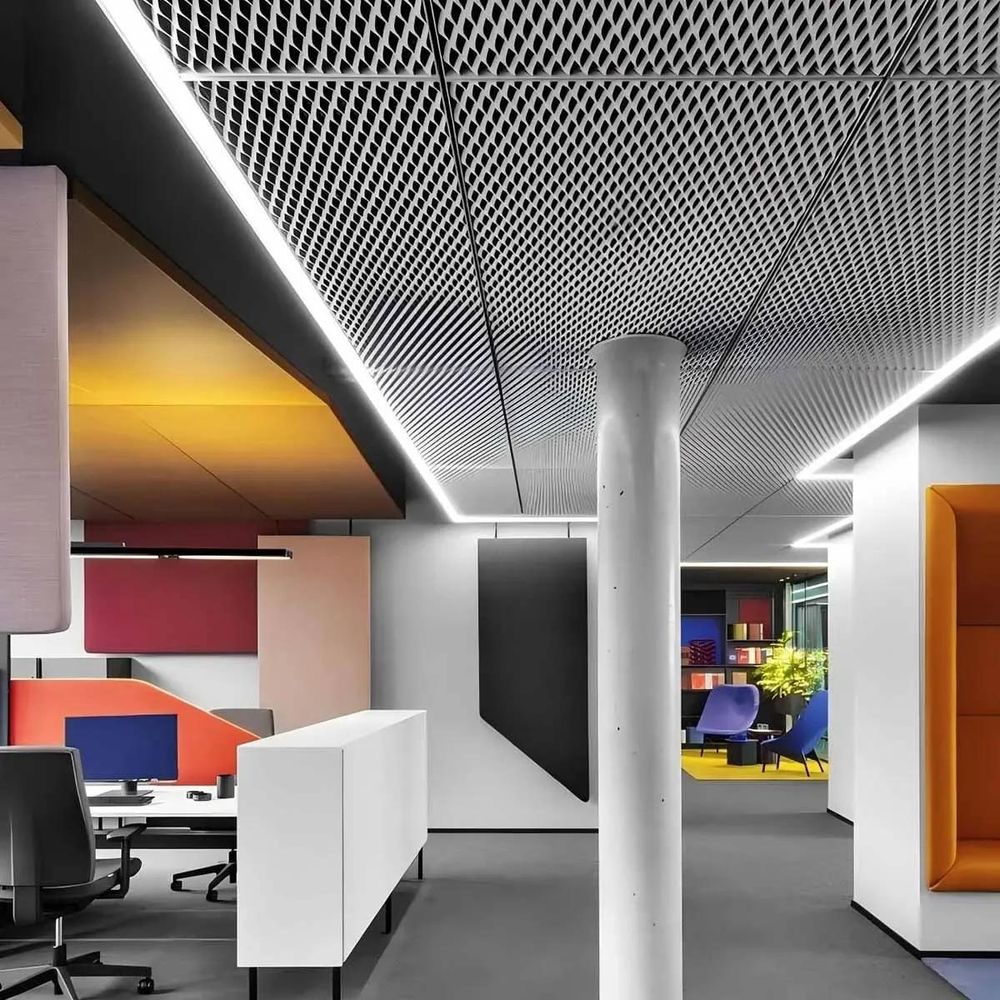
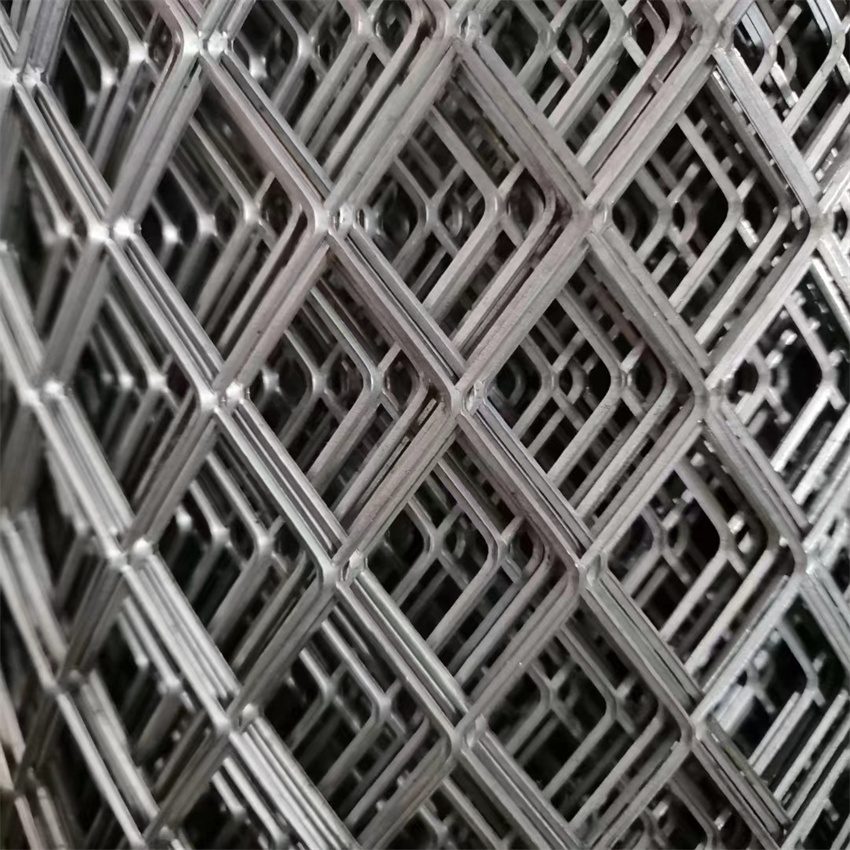
Expanded mesh is the same process in both metals: slit, stretch, work-harden. What changes is density and how the surface behaves — aluminium at about 2.7 g/cm³ against steel at 7.85, and an oxide layer that forms by itself against a zinc layer that has to be applied.
The comparison that matters
| Aluminium expanded | Steel expanded | |
|---|---|---|
| Weight, same panel | About one third | Reference |
| Stiffness | Deflects roughly 3× more at equal thickness | Stiffer, carries load |
| Corrosion | Own oxide layer; no coating needed indoors | Needs zinc, then paint for colour |
| Finish | Anodised in clear, champagne, bronze, black; PVDF | Hot-dip galvanized; powder coat over it |
| Cutting and handling | Two people handle a 1200 × 2400 panel | Needs lifting gear or two people at small sizes |
| Cost per m² | Higher per kg, often lower per installed panel | Lower material cost, higher handling cost |
| Best at | Ceilings, facades, partitions, signage | Walkways, floors, guards, structure |
Where aluminium wins
- Ceilings and canopies — the panel has to hang from a grid, not carry anything, so weight is the only number that matters.
- Facades and cladding — no maintenance cycle, and a PVDF finish holds colour on a sun-facing wall.
- Retrofit work — an existing ceiling grid or wall can take the extra panel weight without new structure.
- Coastal interiors — salt air attacks steel at every cut edge; aluminium does not care.
Where steel wins
- Floors, walkways and treads — stiffness is the whole job, and aluminium at the same thickness will feel spongy.
- Machine guards — impact resistance and the cost of a heavier gauge favour steel.
- Structural or load-bearing panels — steel expanded mesh is used as reinforcement in concrete and screed.
- Budget projects — per square metre, galvanized steel is usually the cheaper answer.
The mistake to avoid
Aluminium mesh used as a floor. It is soft, it work-hardens and cracks at the nodes under repeated foot traffic, and a raised aluminium tread grinds away at the walking lanes within a couple of seasons. If a tread has to be light, use a thicker aluminium section with a deeper return, not a thin sheet.
For any exterior, the alloy matters as much as the finish: 5052 with PVDF for coastal work, 3003 with PVDF inland. 1100 is an interior alloy, whatever the coating says.