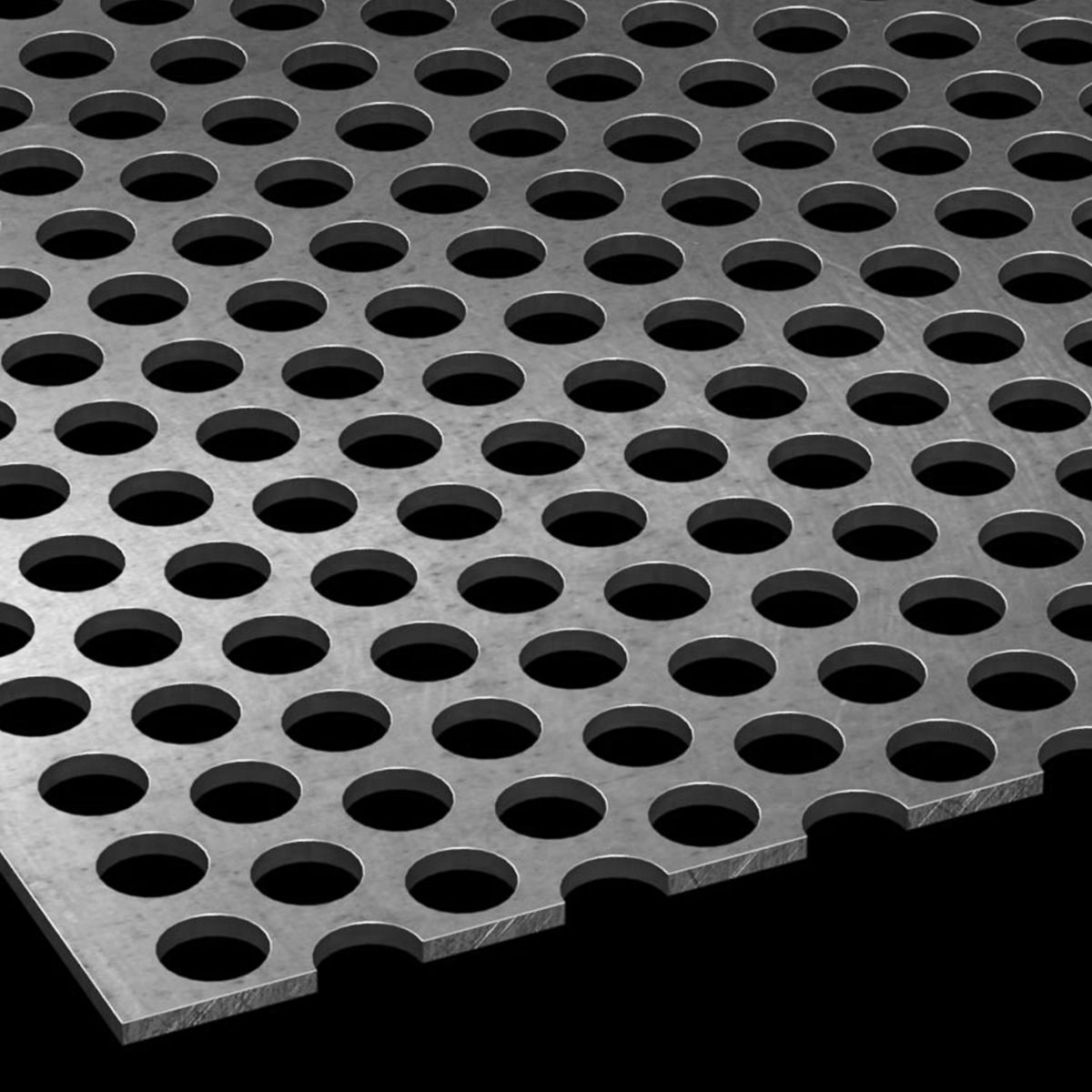
A perforated sheet is described by hole size, pitch and pattern. Open area — the percentage of the sheet that is hole — follows from those three, and open area is what drives airflow, weight, stiffness and price.
The two formulas
For round holes on a straight grid, each hole owns a square cell of pitch × pitch:
For a staggered 60° pattern, each hole owns a rhombus with the same side length but a smaller area, so the same pitch yields more open area:
Worked examples
| Hole | Pitch | Pattern | Open area |
|---|---|---|---|
| 2 mm | 4 mm | 60° staggered | 22.7 % |
| 3 mm | 5 mm | 60° staggered | 32.6 % |
| 5 mm | 8 mm | 60° staggered | 35.4 % |
| 5 mm | 8 mm | Straight row | 30.7 % |
| 8 mm | 12 mm | 60° staggered | 40.3 % |
Those figures are what a supplier should quote. If two quotations claim the same hole and pitch but different open areas, one of them is wrong — or one is quoting a different pattern.
The limits of punching
- Hole ≥ sheet thickness. A 1 mm hole in 2 mm plate destroys punches; expect laser or etching instead, at a different price.
- Open area above roughly 60 % at small hole sizes gets difficult — the punches crowd each other and the sheet distorts.
- Edge margin of at least one hole diameter, otherwise the edge deforms when folded or lifted.
- Holes smaller than 0.5 mm are usually a chemical etching job, not a punching job.
What to put on the drawing
Hole shape and size, pitch, pattern angle, sheet thickness, overall sheet size, material and finish, plus any margin band at the edge. With those on one page, a quotation needs no follow-up questions — and the sheet that arrives matches the one you designed.